
Multicloud AI & ERP / Cloud & AI Security, Governance & Compliance
Why it matters
Security teams drown in alerts from clouds, identities, endpoints and networks. Without correlation and automation, real attacks hide in the noise and responses take hours.
How it works
From log to resolved incident
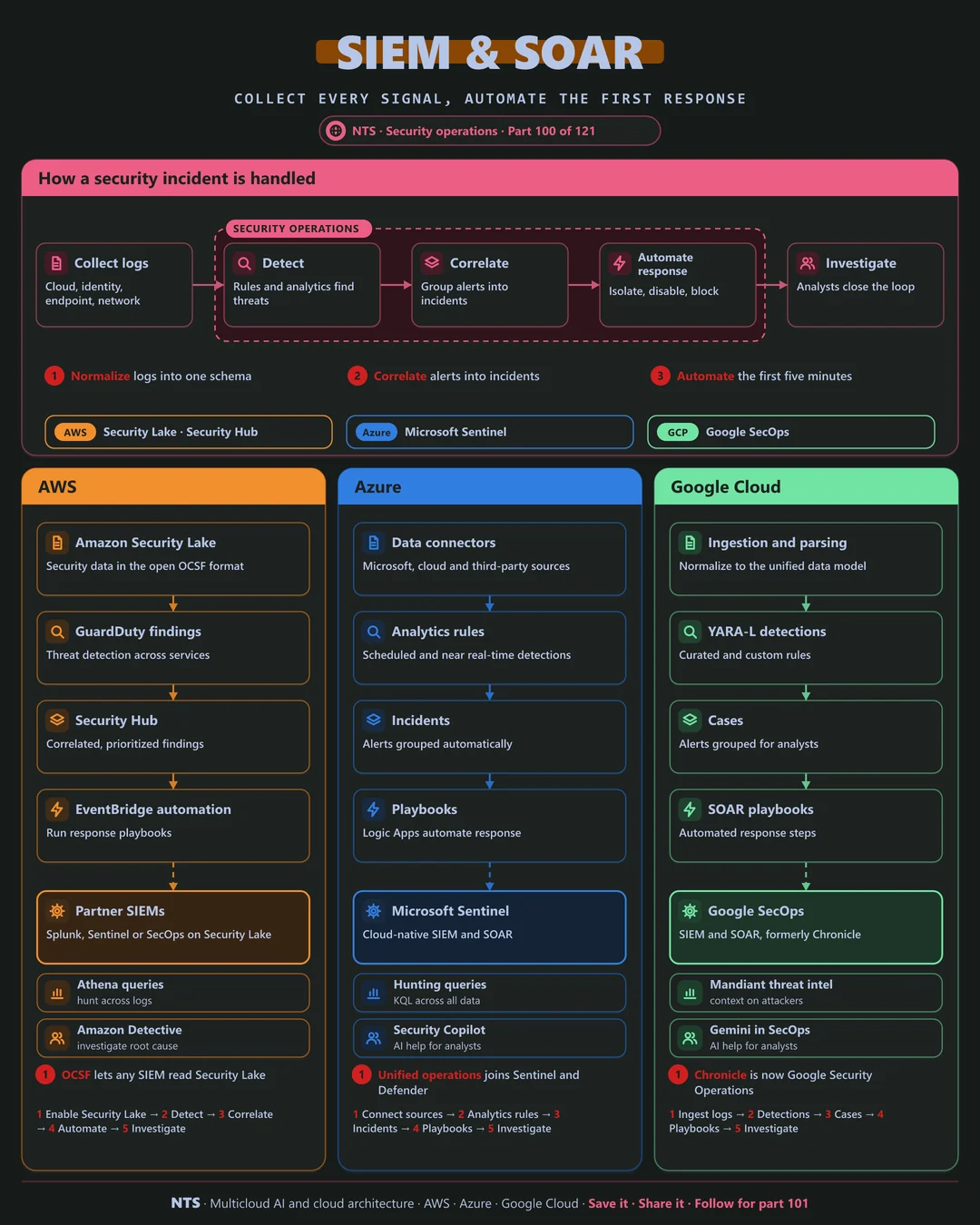
Collect logs from cloud, identity, endpoint and network sources. Detect threats with rules and analytics. Correlate related alerts into incidents. Automate the first response, such as isolating a host or disabling an account, and let analysts investigate the rest.
AWS, Azure and Google Cloud compared
| AWS | Azure | Google Cloud | |
|---|---|---|---|
| SIEM | Security Lake with partner SIEMs | Microsoft Sentinel | Google SecOps |
| Data format | Open Cybersecurity Schema (OCSF) | Log Analytics tables | Unified data model |
| Detections | GuardDuty, Security Hub | Analytics rules | YARA-L, curated detections |
| Automation | EventBridge, Step Functions | Logic Apps playbooks | SOAR playbooks |
| AI for analysts | Security Hub AI summaries | Security Copilot | Gemini in SecOps |
What makes each cloud different
AWS
Amazon Security Lake centralizes security data in the open OCSF format so any SIEM can read it, with GuardDuty and Security Hub supplying findings and EventBridge automating response.
Azure
Microsoft Sentinel is a cloud-native SIEM and SOAR, increasingly unified with Defender, with Logic Apps playbooks and Security Copilot assisting analysts.
Google Cloud
Google Security Operations, formerly Chronicle, combines SIEM and SOAR with Mandiant threat intelligence and Gemini assistance for investigations.
Design decisions that matter
- 01Normalize data into one schema
Detections work across sources.
- 02Correlate before alerting
Incidents, not raw alerts.
- 03Automate the first five minutes
Containment without waiting.
- 04Measure time to respond
And improve it every quarter.
Common mistakes we see
- Collecting everything, using little. Costs without detection value.
- Alert fatigue. Analysts ignore the noise and miss attacks.
- Manual containment. Attackers move faster than tickets.
A practical 30-day plan
- Week 1
Connect cloud and identity log sources.
- Week 2
Enable and tune core detections.
- Week 3
Build playbooks for the top three incident types.
- Week 4
Measure response times and refine.
How NTS helps
NTS deploys and tunes Sentinel, Google SecOps and AWS Security Lake-based SIEMs, covering data onboarding, detections, automation playbooks and SOC processes.
What you get
- SIEM deployment on Sentinel, Google SecOps or Security Lake
- Detection rules for your environment
- Automated response playbooks
- Security operations dashboards
Typical outcomes
- Faster threat detection and response
- Fewer false alarms for analysts
- Predictable SIEM costs
How we work with you
- 1Assess
A focused review of your SIEM and SOAR across AWS, Azure and Google Cloud. We look for the gaps we find most often: collecting everything, using little, alert fatigue and manual containment.
- 2Design
A target architecture and roadmap built on the decisions that matter most: normalize data into one schema, correlate before alerting, automate the first five minutes and measure time to respond.
- 3Build
Hands-on delivery alongside your team. We connect cloud and identity log sources, enable and tune core detections, build playbooks for the top three incident types, and finally measure response times and refine.
- 4Run and improve
We add detections, tune rules and improve playbooks as threats evolve.
Why teams choose NTS for SIEM and SOAR
- Detection that fits you
We tune rules to your environment to reduce false alarms.
- Automated response
Playbooks contain threats in minutes.
- Cost-aware logging
We control ingestion costs without losing visibility.
Book a free 30-minute review
Talk to an NTS architect about your SIEM and SOAR on AWS, Azure and Google Cloud.