
Multicloud AI & ERP / Cloud Data, Analytics & BI for AI
Why it matters
Retailers, advertisers, banks and healthcare organizations gain from combining data, for example to measure campaigns or detect fraud across institutions. Privacy laws and trust make raw data sharing impossible.
How it works
How a clean room works
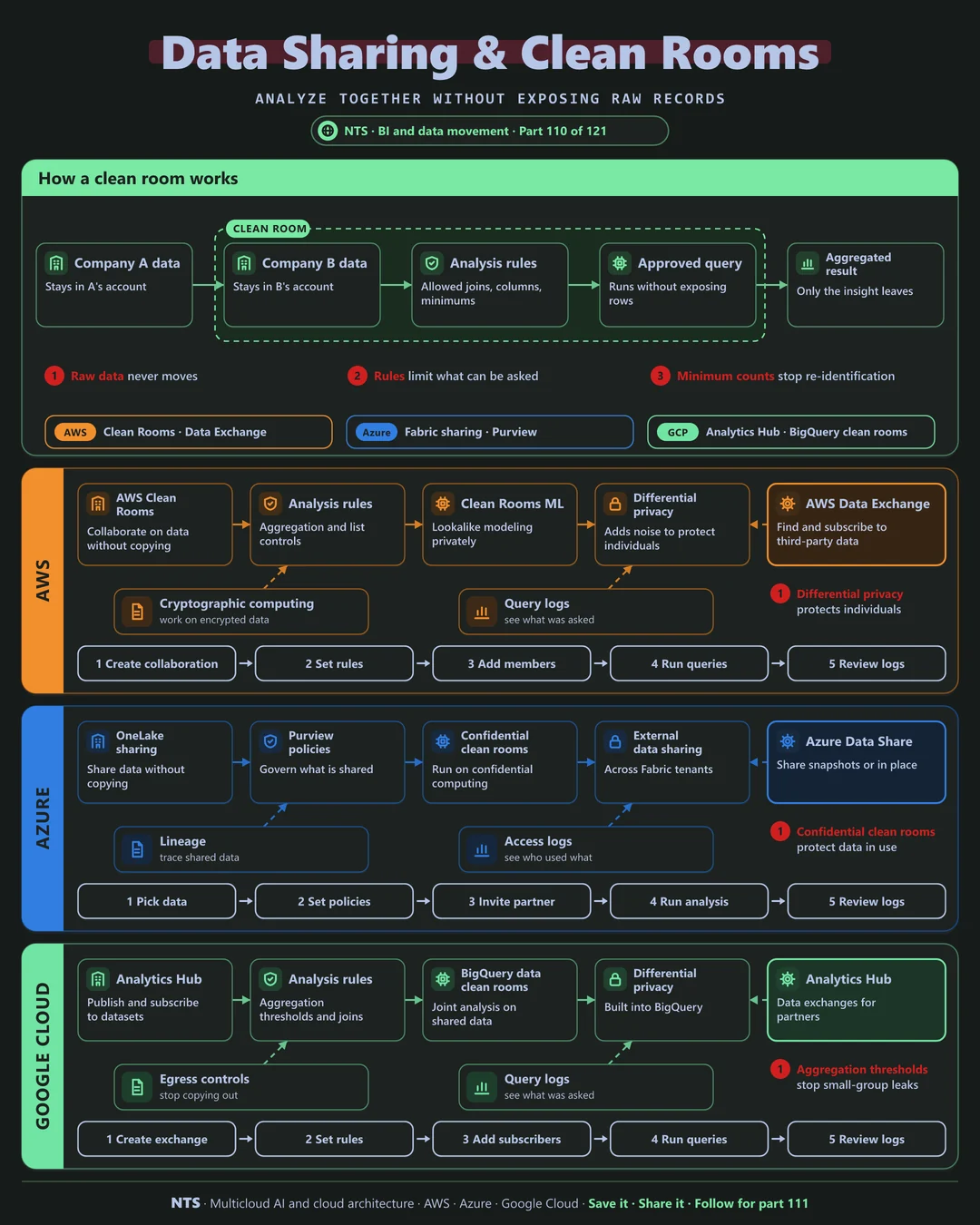
Each party's data stays in its own account. Analysis rules define allowed joins, columns and minimum group sizes. Approved queries run without exposing individual rows, and only aggregated results leave the room.
AWS, Azure and Google Cloud compared
| AWS | Azure | Google Cloud | |
|---|---|---|---|
| Clean room | AWS Clean Rooms | Confidential clean rooms (Azure) | BigQuery data clean rooms |
| Data sharing | AWS Data Exchange | OneLake external sharing, Azure Data Share | Analytics Hub |
| Analysis rules | Aggregation and list rules | Purview and confidential computing policies | Aggregation thresholds |
| Privacy techniques | Differential privacy, cryptographic computing | Confidential computing | Differential privacy |
| Joint ML | Clean Rooms ML | Azure ML in confidential environments | BigQuery ML in clean rooms |
What makes each cloud different
AWS
AWS Clean Rooms lets parties collaborate without copying data, with analysis rules, differential privacy and Clean Rooms ML for privacy-preserving lookalike modeling.
Azure
Azure supports confidential clean rooms on confidential computing, OneLake sharing across Fabric tenants and Purview governance over what is shared.
Google Cloud
BigQuery data clean rooms, built on Analytics Hub, apply aggregation thresholds, join restrictions and differential privacy, with egress controls to prevent copying out.
Design decisions that matter
- 01Share insights, not raw data
Aggregates only.
- 02Minimum group sizes
Prevent re-identification.
- 03Legal and privacy review upfront
Agree rules before data moves.
- 04Log every query
Full transparency for all parties.
Common mistakes we see
- Sharing extracts by file transfer. Data lost to your control.
- No minimum thresholds. Small groups expose individuals.
- One-sided rules. Partners stop trusting the setup.
A practical 30-day plan
- Week 1
Agree the use case and rules with the partner.
- Week 2
Set up the clean room and connect data.
- Week 3
Run approved queries and review results.
- Week 4
Add privacy techniques and scale the collaboration.
How NTS helps
NTS sets up data clean rooms and sharing on AWS, Azure and Google Cloud, covering use-case design, analysis rules, privacy techniques and partner onboarding.
What you get
- Clean room setup with your partners
- Privacy controls and approved queries
- Data sharing agreements turned into technical rules
- Insight reports from joint analysis
Typical outcomes
- New insights from partner data
- Privacy and contracts respected
- New revenue opportunities from collaboration
How we work with you
- 1Assess
A focused review of your data sharing and clean rooms across AWS, Azure and Google Cloud. We look for the gaps we find most often: sharing extracts by file transfer, no minimum thresholds and one-sided rules.
- 2Design
A target architecture and roadmap built on the decisions that matter most: share insights, not raw data, minimum group sizes, legal and privacy review upfront and log every query.
- 3Build
Hands-on delivery alongside your team. We agree the use case and rules with the partner, set up the clean room and connect data, run approved queries and review results, and finally add privacy techniques and scale the collaboration.
- 4Run and improve
We onboard new partners, update rules and expand joint analysis.
Why teams choose NTS for data sharing and clean rooms
- Collaborate without exposing data
Partners gain insight while raw data stays private.
- Privacy-first design
Controls meet legal and contractual requirements.
- Cross-cloud sharing
We connect partners on different clouds.
Book a free 30-minute review
Talk to an NTS architect about your data sharing and clean rooms on AWS, Azure and Google Cloud.