
Multicloud AI & ERP / Cloud Migration, Integration & AI Operations
Why it matters
Architecture diagrams promise resilience; only real failures prove it. Chaos engineering finds weak spots in a controlled way, before a real outage finds them for you.
How it works
A safe experiment
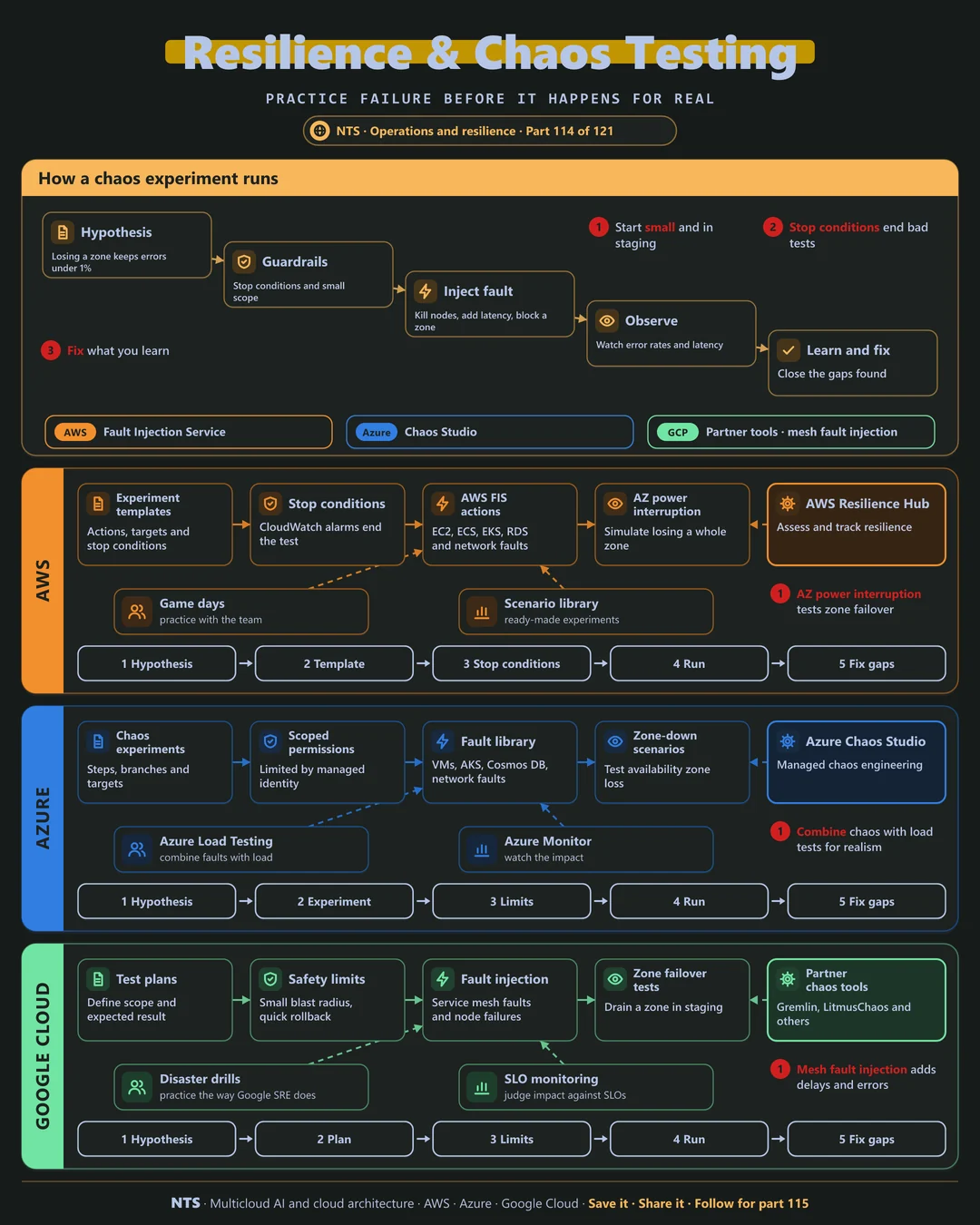
Write a hypothesis, for example that losing a zone keeps errors under 1%. Set guardrails: small scope and automatic stop conditions. Inject the fault, observe error rates and latency, then learn and fix the gaps you find.
AWS, Azure and Google Cloud compared
| AWS | Azure | Google Cloud | |
|---|---|---|---|
| Chaos service | AWS Fault Injection Service | Azure Chaos Studio | Partner tools and mesh fault injection |
| Zone loss scenario | AZ power interruption | Zone-down experiments | Zone drain in staging |
| Stop conditions | CloudWatch alarms | Scoped permissions and limits | Tool-specific safety limits |
| Resilience tracking | AWS Resilience Hub | Azure Advisor reliability | SLO monitoring |
| Load testing | Distributed load testing solutions | Azure Load Testing | Partner and open-source tools |
What makes each cloud different
AWS
AWS Fault Injection Service runs experiments across EC2, ECS, EKS, RDS and networking, including an AZ power interruption scenario, with CloudWatch alarms as automatic stop conditions.
Azure
Azure Chaos Studio provides a fault library for VMs, AKS, Cosmos DB and networks, scoped by managed identity, and pairs well with Azure Load Testing for realistic conditions.
Google Cloud
Google Cloud relies on partner tools such as Gremlin and LitmusChaos and on service mesh fault injection for delays and errors, judged against SLOs in the style of Google SRE.
Design decisions that matter
- 01Start in staging, small scope
Then graduate to production.
- 02Automatic stop conditions
Experiments end themselves if needed.
- 03Test zone loss first
The most likely large failure.
- 04Make it a routine
Game days every quarter.
Common mistakes we see
- Chaos without observability. You cannot learn what you cannot see.
- No hypothesis. Breaking things is not the goal.
- Never fixing findings. The same weakness fails in a real outage.
A practical 30-day plan
- Week 1
Pick a critical service and write hypotheses.
- Week 2
Set up the chaos tool with stop conditions.
- Week 3
Run a zone-loss experiment in staging.
- Week 4
Fix the gaps and schedule regular game days.
How NTS helps
NTS runs resilience programs on AWS, Azure and Google Cloud, covering chaos experiment design, game days, observability readiness and fixing the weaknesses they reveal.
What you get
- Resilience hypotheses for critical services
- Chaos experiments with automatic stop conditions
- Game days with your teams
- A fix list for weaknesses found
Typical outcomes
- Proven recovery from zone and dependency failures
- Teams confident during incidents
- Fewer surprises in real outages
How we work with you
- 1Assess
A focused review of your resilience and chaos testing across AWS, Azure and Google Cloud. We look for the gaps we find most often: chaos without observability, no hypothesis and never fixing findings.
- 2Design
A target architecture and roadmap built on the decisions that matter most: start in staging, small scope, automatic stop conditions, test zone loss first and make it a routine.
- 3Build
Hands-on delivery alongside your team. We pick a critical service and write hypotheses, set up the chaos tool with stop conditions, run a zone-loss experiment in staging, and finally fix the gaps and schedule regular game days.
- 4Run and improve
We run quarterly game days and expand experiments to more services.
Why teams choose NTS for resilience and chaos testing
- Failure rehearsed, not feared
We practice outages so real ones are calm.
- Safe experiments
Small scopes and stop conditions protect customers.
- Learning that sticks
Every experiment ends with concrete fixes.
Book a free 30-minute review
Talk to an NTS architect about your resilience and chaos testing on AWS, Azure and Google Cloud.